Bhotekoshi Flood Causes Rs. 472.66 Billion in Damage; Rs. 706.65 Billion Needed for Reconstruction
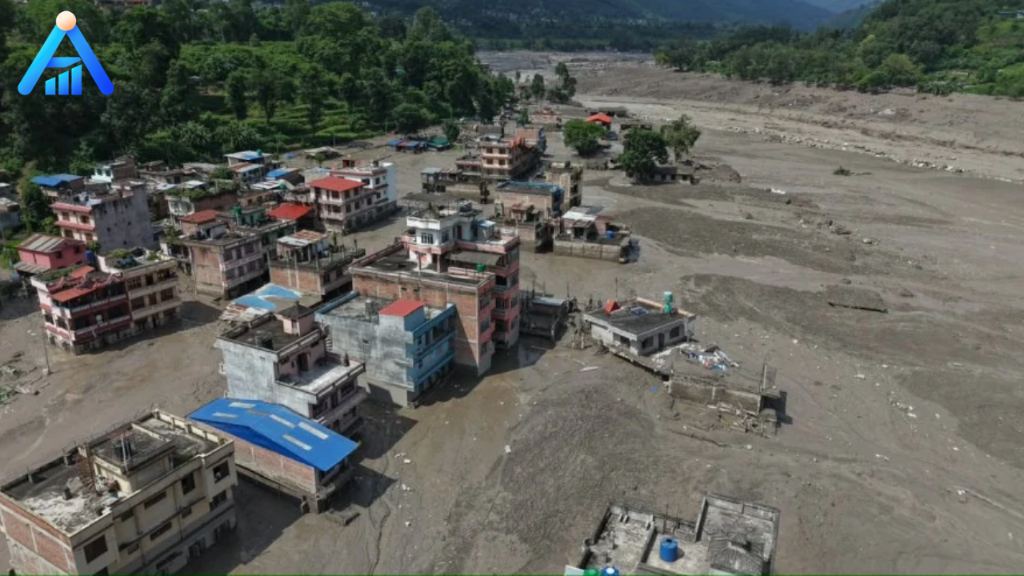
The devastating flood in the Rasuwa–Bhotekoshi River on Bhadra 10, 2083, caused significant damage to lives, property and infrastructure in Nepal. According to the preliminary Post-Disaster Needs Assessment (PDNA) report prepared by the National Planning Commission, the total damage and economic losses from the disaster are estimated at Rs. 472.66 billion.
The report estimates that Rs. 706.65 billion will be required for the reconstruction of damaged infrastructure, rehabilitation of affected communities and recovery of affected economic and social sectors. The preliminary report was made public on Kartik 20, 2083.
According to the assessment, the disaster caused physical damage worth Rs. 282.90 billion, while economic losses amounted to Rs. 189.76 billion.
Flood Claims 1,464 Lives; Thousands Still Missing
The report states that 1,464 people lost their lives in the disaster, while 5,285 Nepalese and foreign nationals remain missing. A total of 13,795 people were rescued following the disaster. The flood also forced a large number of families to leave their homes and relocate to safer areas.
Private Sector Suffers Greater Losses
According to the report, the private sector suffered damage and losses worth Rs. 254.03 billion, while the public sector recorded losses of Rs. 218.63 billion.
In the private sector, residential and commercial buildings, agriculture, livestock, vehicles, employment and daily income were significantly affected.
Meanwhile, public infrastructure, including hydropower projects, roads, bridges, government offices, customs facilities, schools, health institutions and banking infrastructure, also sustained substantial damage.
Infrastructure Sector Records the Highest Damage
Among the assessed sectors, infrastructure experienced the highest level of damage and losses, estimated at Rs. 174 billion. The reconstruction of this sector alone is expected to require Rs. 382.83 billion.
Similarly, the productive sector suffered damage and losses worth Rs. 136.77 billion. An estimated Rs. 145.77 billion will be required for its recovery.
The climate and environment sector recorded damage and losses of Rs. 121.68 billion, with Rs. 94.43 billion estimated to be necessary for recovery.
The social sector suffered losses worth Rs. 39 billion, while approximately Rs. 57.77 billion will be required for rehabilitation and recovery.
Economic Growth Could Decline by One Percentage Point
The report highlights that the flood disrupted production, transportation, energy infrastructure, trade, tourism, agriculture and employment, creating challenges for both local and national economic activities.
Nepal's economic growth rate, which was projected at 7% for the current fiscal year, could decline by approximately one percentage point due to the disaster.
The assessment also projects that the consumption-based poverty rate in flood-affected local governments could increase from 12.2% to 14.9%, representing a rise of 2.7 percentage points.
Assessment Conducted Across 15 Local Governments in Five Districts
The National Planning Commission conducted the assessment across six sectors and 22 cross-cutting areas to evaluate the disaster's impact and determine reconstruction requirements.
During the study, 156 personnel were mobilized through 56 teams across 15 local governments in five districts. Household and establishment surveys were conducted for two weeks beginning on Ashoj 2, using digital data collection systems.
The assessment collected information on the impact on households and businesses, physical and economic damage, livelihoods, displacement and rehabilitation needs.
The report recommends that reconstruction should go beyond simply restoring damaged structures to their previous condition. It emphasizes improving infrastructure quality, adopting modern technology and implementing disaster risk reduction measures.
It also highlights the importance of making affected areas safer and more resilient to future disasters through long-term rehabilitation and reconstruction efforts.